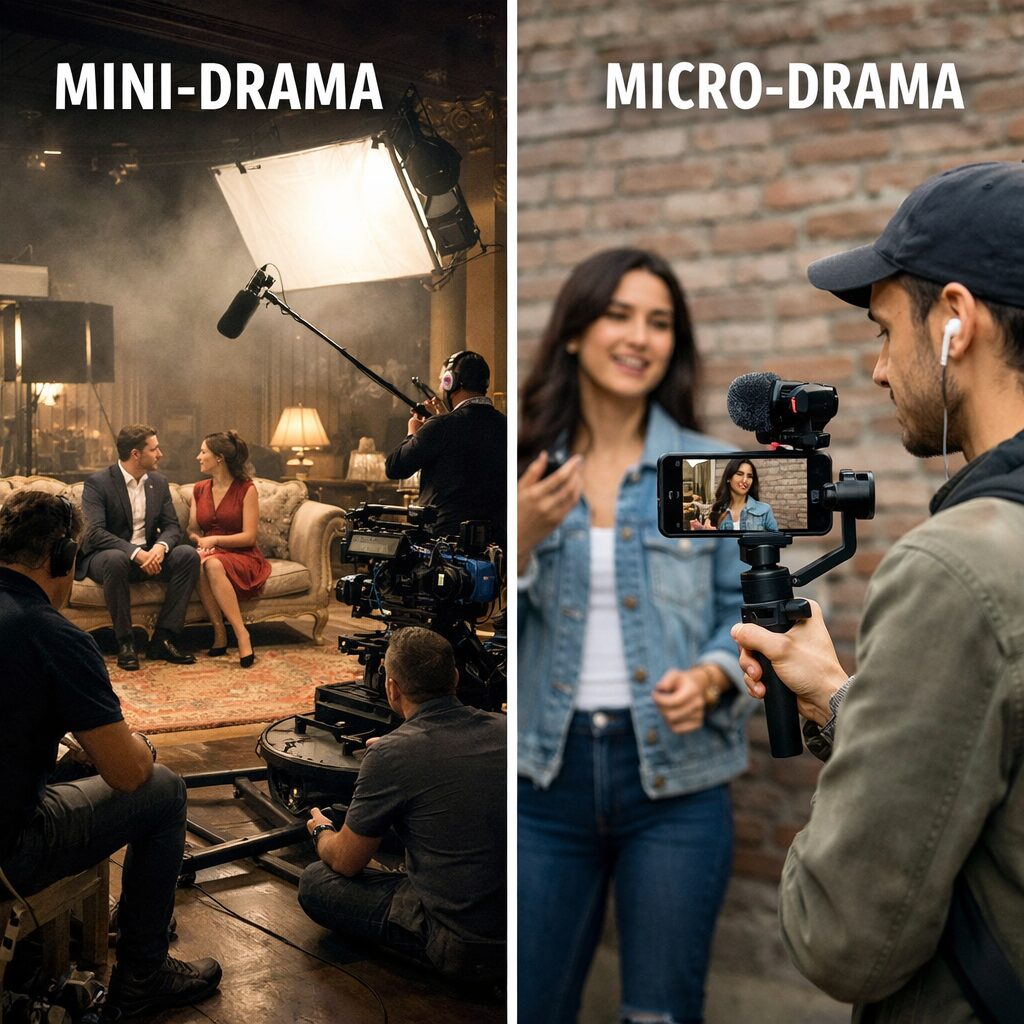
Mini Drama vs Micro Drama: What’s the Difference (and What “Free Episodes” Actually Means)
If you’re new to short-form series, the names can feel like a mess: mini drama, micro drama, vertical drama, short drama, short TV series… and people use them like they all mean the same thing.
Sometimes they do. Sometimes they don’t.
This guide is here so you can:
- understand what people usually mean by mini drama vs micro drama
- know what episode lengths to expect (so you’re not surprised)
- understand what “free episodes” usually means on these apps
- search smarter and find full series faster
This article contains affiliate links.
Quick app links:
Shortical
AppReel
The short answer
Most of the time:
- Micro drama = very short episodes (often around 1–3 minutes), usually made for mobile viewing, often vertical.
- Mini drama = can mean the same thing, but sometimes it’s used more broadly for “shorter-than-normal” series, including episodes that are longer than micro dramas.
So the “difference” is real in theory, but in everyday search, the terms overlap heavily.
The longer answer (without making it complicated)
Here’s the best way to think about it:
1) “Vertical” describes the screen format
Vertical drama means the show is designed for a phone held upright (portrait). It’s about framing, not story.
2) “Micro” describes the episode length and pacing
Micro drama usually implies very short episodes and fast cliffhangers. The storytelling is built to keep you tapping “next.”
3) “Mini” is the loosest term
Mini drama gets used in two main ways:
- As a synonym for micro drama (especially in app titles and casual conversation)
- As a broader label for short scripted series that are still “short,” but not necessarily 1–3 minutes per episode
If you only remember one thing: micro drama is the more specific term. Mini drama is the catch-all.
Table 1 — Mini drama vs micro drama vs vertical drama (quick comparison)
| Term | What it usually means in search | Typical episode feel | What to type if you’re trying to find a show |
|---|---|---|---|
| Micro drama | Very short serialized episodes, often made for phones | Fast hooks, cliffhangers, lots of parts | “micro drama”, “micro drama series”, “one minute drama”, “short drama episodes” |
| Mini drama | Sometimes same as micro drama; sometimes just “short series” | Can be fast like micro dramas, or slightly longer | “mini drama”, “mini series short episodes”, “short drama app” |
| Vertical drama | The format is vertical/portrait (phone-first) | Can be micro length or longer short episodes | “vertical drama”, “vertical series”, “portrait drama” |
| Short drama / short TV series | Broad umbrella term | Anything from micro to short episodes | “short drama app”, “watch short drama series” |
“Myth vs Fact” (because the comments are often wrong)
Myth: Mini dramas are always longer than micro dramas.
Fact: Sometimes yes, sometimes no. On many apps, “mini drama” is basically the same thing as micro drama, just a friendlier name.
Myth: Vertical drama is a genre.
Fact: It’s mostly a format choice. The genre can be romance, revenge, fantasy, comedy, crime-ish… anything.
Myth: If the title from the clip doesn’t work, the show is gone.
Fact: A lot of clip titles are translated weirdly, shortened, or made up. Search by trope words (more on that below).
Myth: “Free episodes” means you can watch the full series for free.
Fact: Usually you can start free, then you hit an unlock system. The exact method depends on the app.
How long are these episodes, really?
There’s no single universal number across every platform, but “micro dramas / verticals” are commonly described as very short, often around one to three minutes per episode.
That explains why a show can have 60–100 “episodes” and still feel like a quick binge. It’s one long story broken into a lot of small parts.
Mini drama is where you’ll see more variation:
- sometimes it still means 1–3 minute episodes (same as micro)
- sometimes it means “short series” where episodes are longer than that
If you’re searching, this is the practical hack:
- If you want the smallest episodes possible, search “micro drama” or “one minute drama.”
- If you’re okay with slightly longer episodes, “mini drama” and “short drama series” can be better keywords.
The part nobody explains well: what “free episodes” usually means
On short drama apps, “free” often means:
- the app is free to install
- you can watch the first few episodes free
- then the app asks you to unlock more episodes (usually right at a cliffhanger)
That “unlock” can be done a few ways, and this is where people get annoyed if they don’t expect it.
Table 2 — Common “free” models in short drama apps
| What you’ll see | What it means | Best for | Watch out for |
|---|---|---|---|
| First episodes free | You get a sample, then it gates later episodes | Testing shows quickly | You may hit the paywall right when it gets good |
| Watch ads to unlock | Ads act like “tickets” for the next episode | Patient binge watching | Ads can stack up fast across many episodes |
| Wait timers | You unlock episodes by waiting (daily/periodic) | Slow, casual viewing | Cliffhangers make waiting feel worse than it sounds |
| Coins / passes | You buy credits to unlock episodes | People who binge hard | Costs can creep up if you unlock episode-by-episode |
| Subscription / VIP | Pay monthly for easier access | Regular viewers | Check what’s included; some content may still be gated |
| Season bundle | Pay once to unlock the full story | People who know they’re committed | Make sure it’s the correct series |
A simple, calm approach is:
- Watch the first 3–5 episodes to confirm you actually like it
- If yes, decide whether you’re a “slow unlock” person or a “just give me the season” person
- If no, move on fast (don’t get emotionally trapped by episode 6)
How to find a show when the clip title is fake (this works for both mini and micro dramas)
Don’t start by searching the clip title. Titles get changed constantly.
Instead, search by trope using a 3-part phrase:
[TROPE] + [RELATIONSHIP] + [STAKES]
Examples you can copy:
- contract marriage + CEO + secret
- fake dating + boss + scandal
- secret heiress + inheritance + exposed
- rejected mate + alpha + regret
- revenge + ex + betrayal
This method works because the short drama ecosystem leans heavily on recognizable tropes. The tropes are the real “index.” The title is often just decoration.
Table 3 — “What should I search?” based on the vibe you want
| You want this vibe | Search words that usually work |
|---|---|
| Rich romance / CEO | billionaire, CEO, boss, contract marriage, secret marriage |
| Fake dating | fake dating, contract, engagement deal, pretend couple |
| Revenge | revenge, betrayal, exposed, framed, comeback |
| Werewolf / alpha | alpha, mate, rejected mate, fated mates, pack |
| Second chance | ex, regret, divorce, reunion, second chance |
| Family secrets | heiress, inheritance, hidden identity, secret child |
Where to watch (simple, not overwhelming)
If you’re trying to avoid downloading a bunch of apps, a clean two-step test is:

Why this order?
- Shortical tends to be a strong starting point for browsing and trope searching.
- AppReel is a solid second catalog if you want faster micro-episode pacing or you didn’t find the show on the first try.
You’ll also hear people talk about apps like DramaBox, ReelShort, ShortMax, ShortTV. Those are popular benchmarks, but you don’t need to start there if your goal is to test newer options first.
Quick recap
- Micro drama is the more specific term: very short episodes, fast cliffhangers, usually phone-first.
- Mini drama is looser: sometimes the same as micro drama, sometimes just “short series.”
- “Free episodes” usually means you can start free, then you unlock more episodes using ads, timers, coins, or a subscription.
- Best way to find a show is trope search, not title search.
- If you want a simple two-app workflow: Shortical first, then AppReel.